
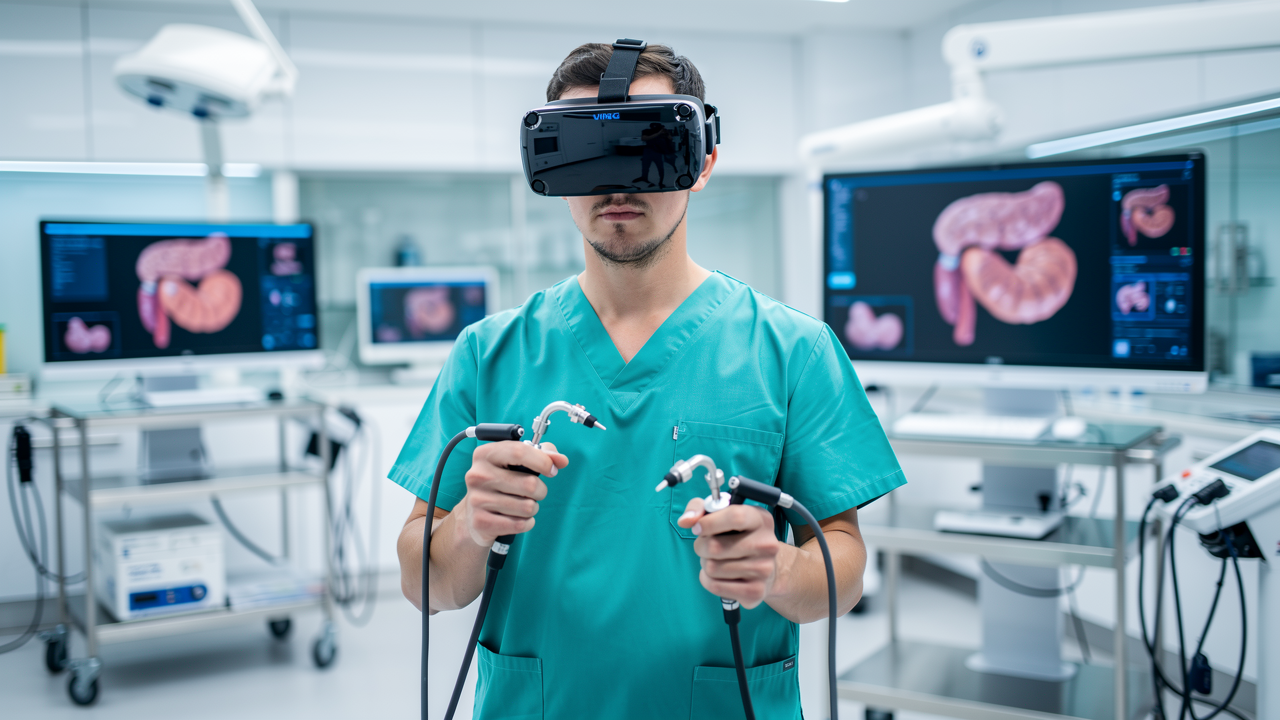
How Does Virtual Reality Training Change Laparoscopic Skill Acquisition?
Laparoscopic surgery demands hand-eye coordination that differs sharply from open procedures. Instruments move opposite to hand direction on screen, and depth perception relies on a flat monitor rather than direct vision. Virtual reality simulators recreate this environment without involving a patient, allowing repeated practice of grasping, cutting, and suturing motions until movements become automatic. A systematic review covering 31 randomized controlled trials found that VR training produced better outcomes than video-based trainers and matched the results of physical box trainers, particularly for trainees with no prior laparoscopic exposure.
The value of this approach lies in repetition without consequence. A trainee can attempt the same knot-tying sequence dozens of times in a single session, receiving immediate feedback on instrument path and tissue handling. This differs from traditional apprenticeship models, where opportunities to practice depend on operating room availability and patient case mix.
A Trainee's First Weeks on a VR Simulator
Consider a surgical resident starting a minimally invasive rotation. In the first sessions, basic tasks such as peg transfer or object positioning reveal weaknesses in depth judgment and instrument control. Over subsequent weeks, the same tasks become routine, and the simulator introduces more complex modules involving simulated bleeding or restricted visual fields.
Why Proficiency Benchmarks Matter Here
Most modern VR curricula are proficiency-based rather than time-based. A trainee does not move to the next module after a fixed number of hours but only after meeting defined speed and accuracy thresholds. This structure prevents advancement based on attendance alone and ensures that skill, not calendar time, determines readiness for supervised live cases.
VR Simulators Versus Box Trainers
Both tools aim to build laparoscopic dexterity outside the operating room, but they differ in feedback type, cost structure, and realism of certain tasks.
| Feature | VR Simulator | Box Trainer |
|---|---|---|
| Feedback on instrument path | Automated, quantitative | Requires observer |
| Haptic sensation | Variable, improving | Physical, direct |
| Task variety | Software-based modules | Limited to physical models |
| Setup and maintenance | Higher initial cost | Lower cost, simple upkeep |
| Data tracking | Built-in performance logs | Manual recording needed |
Neither format replaces tissue-based training entirely. Programs that combine simulator repetition with cadaver-based sessions tend to produce trainees who transition more smoothly to live procedures, since cadaveric tissue behaves differently from both virtual models and synthetic box-trainer materials.
Common Mistakes When Introducing VR Into Surgical Curricula
Departments adopting VR simulators sometimes treat the equipment as a standalone solution rather than part of a structured curriculum. Placing a simulator in a resident lounge without assigned modules or supervision rarely produces measurable skill gains. Another frequent error is skipping baseline assessment, which makes it difficult to track whether a trainee has actually improved or simply become familiar with a specific simulated task.
A further mistake involves ignoring the transfer step. Simulator proficiency does not automatically confirm operating room readiness. Programs that omit supervised live-case validation after simulator training risk overestimating a trainee's actual competence.
Measuring Proficiency: What the Evidence Shows
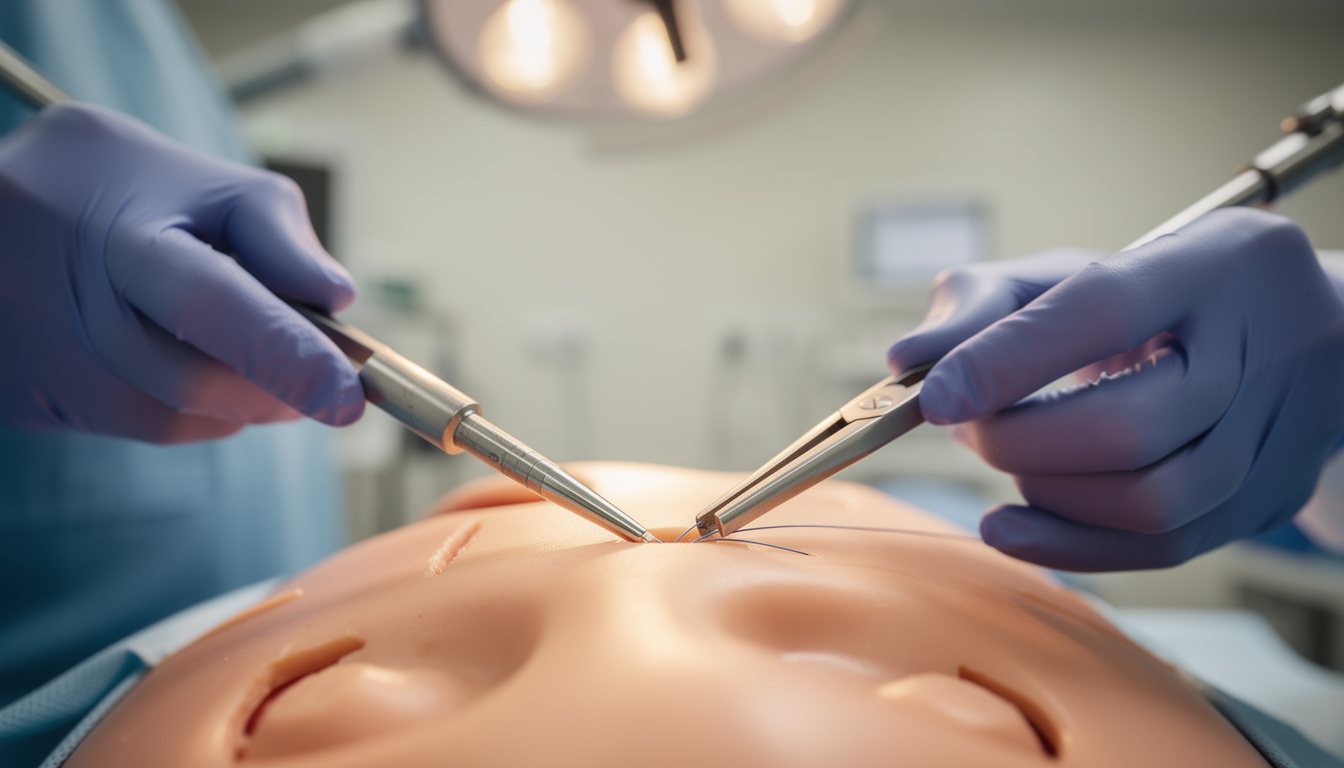
A randomized controlled trial published in the BMJ compared trainees who completed proficiency-based VR training against those who received standard clinical education alone. The VR-trained group operated with roughly half the operating time in real laparoscopic procedures, along with fewer errors during the observed cases. This result is often cited as evidence that skills built in simulation genuinely transfer to patient care, rather than remaining confined to the simulator screen.
A separate Cochrane-style review reached a similar conclusion, noting reduced operating time and improved operative performance among VR-trained surgical trainees compared with no structured training or box-trainer-only groups. The same review cautioned that evidence on long-term clinical outcomes and cost-effectiveness remains limited, meaning institutions should treat VR as one component of training rather than a complete substitute for supervised operative experience.
For additional details, you can visit the business website at: biotechanatomy.co.il.
Where Cadaver-Based Training Still Fits
Virtual reality handles repetition and motion-pattern learning well, but it does not replicate real tissue resistance, bleeding response, or anatomical variation between individuals. Cadaver-based sessions fill this gap, giving surgeons and medical device researchers a physical environment where instruments, energy devices, and implants behave as they would in an actual patient. Facilities offering this kind of practical anatomy training often serve not only surgical trainees but also medical device companies validating new instruments before clinical trials.
Combining simulator hours with periodic cadaver labs allows a training program to address both motor-skill repetition and tissue-level realism, rather than relying on a single training format for every stage of learning.
Frequently Asked Questions
Does VR training replace hands-on surgical practice entirely?
No. Research consistently frames VR as a preparatory and skill-building tool, not a replacement for supervised operating room experience or cadaver-based tissue training.
How long does it take to see measurable improvement on a simulator?
This varies by task complexity and prior experience, but proficiency-based curricula typically require multiple sessions before a trainee consistently meets speed and accuracy benchmarks.
Is VR training useful for experienced surgeons, or only beginners?
Evidence primarily supports its value for trainees with limited laparoscopic experience, though experienced surgeons sometimes use it to rehearse specific complex maneuvers before a procedure.
What is the difference between VR simulators and cadaver labs?
VR simulators focus on repeatable motor-skill drills with digital feedback, while cadaver labs provide real tissue response and anatomical realism that simulators cannot fully reproduce.
About the Business
Biotech Anatomy LTD operates a facility dedicated to practical anatomy and surgical education, providing cadaver-based training and research and development services. Its programs serve surgeons, medical students, healthcare professionals, researchers, and medical device development companies seeking realistic, tissue-based environments for skill development and product testing.
